
ICL Surgery in India: Cost, Procedure & Recovery (2026 Guide)
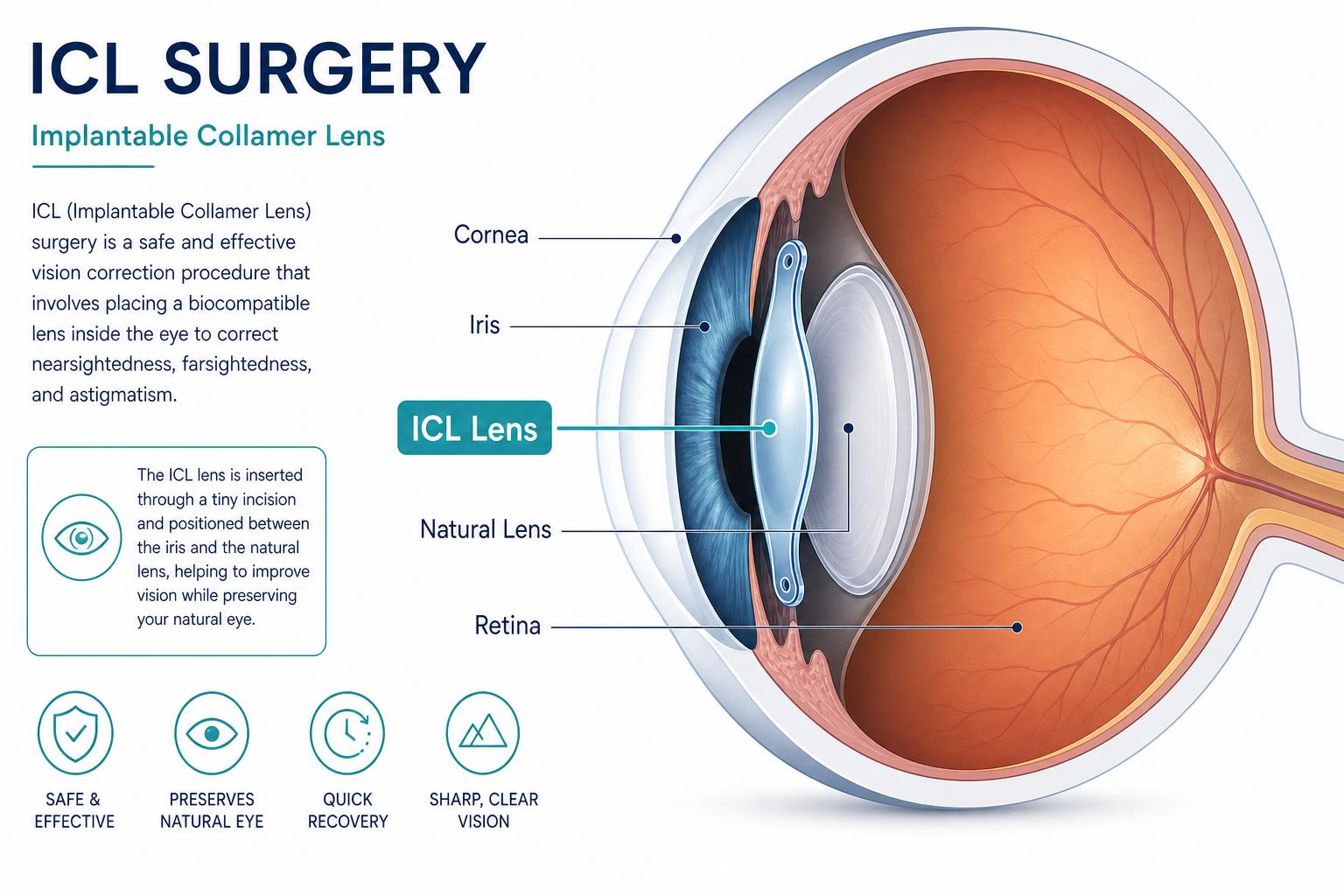
If LASIK isn't an option for you because your cornea is too thin or your power is too high, and glasses or contact lenses are becoming a daily inconvenience, there's a quieter, increasingly popular alternative many patients haven't heard of: ICL surgery.
An Implantable Collamer Lens (ICL) is essentially a permanent contact lens that sits inside your eye, behind the iris and in front of your natural lens. No cornea reshaping. No tissue removed. Reversible if ever needed. In India, the entire procedure typically costs between ₹1.4 lakh and ₹1.8 lakh for both eyes at quality centres.
This guide breaks down everything you need to know: what ICL actually is, who qualifies, how it compares to LASIK, what it costs, and what to expect through the procedure and recovery.
What Is ICL Surgery?
ICL stands for Implantable Collamer Lens — a tiny, flexible lens made from Collamer, a biocompatible collagen-copolymer material used safely in eye surgery for over two decades. The lens is folded, inserted through a 3 mm incision in the cornea, and unfolds gently into position behind the iris.
Unlike LASIK (which reshapes the cornea with a laser) or cataract surgery (which removes the natural lens), ICL adds a lens to your eye without removing or altering any existing tissue. That's why surgeons sometimes call it a 'permanent contact lens you never have to take out.'
The most widely used ICL today is the EVO Visian ICL from STAAR Surgical, which features a central port that allows natural aqueous fluid flow — eliminating the preliminary YAG laser step older ICLs required and making the procedure faster and safer.
Who Is a Good Candidate for ICL Surgery?
ICL is particularly suited for people who cannot have LASIK. Here is a quick eligibility breakdown:
| Criterion | Ideal Range | Notes |
|---|---|---|
| Age | 21 to 45 years | Vision must be stable; refractive history within ±0.5 D for at least one year |
| Myopia (nearsightedness) | -3.00 D to -20.00 D | ICL excels at moderate-to-high myopia where LASIK falls short |
| Astigmatism | Up to 4.00 D | Treated with Toric ICL |
| Hyperopia (farsightedness) | +3.00 D to +10.00 D | Available in select markets |
| Corneal thickness | Any (no minimum) | Major advantage over LASIK |
| Dry eye | Mild to moderate OK | ICL does not worsen dry eye the way LASIK can |
| Anterior chamber depth | ≥ 2.8 mm | Measured during pre-op workup |
| General eye health | No cataract, glaucoma or active retinal disease | Pregnancy or nursing temporarily disqualifies |
You are likely a strong ICL candidate if:
- Your power is above -8.00 D, where LASIK becomes risky
- Your cornea is too thin for LASIK
- You have chronic dry eyes
- You play contact sports or live an active lifestyle and want a reversible option
- You were rejected for LASIK
ICL vs LASIK: An Honest Comparison
Most patients walk in asking for LASIK because it's the brand name they know. Here is how the two procedures actually compare:
| Feature | ICL Surgery | LASIK |
|---|---|---|
| What it does | Adds a lens inside the eye | Reshapes the cornea with laser |
| Power range treated | -3 D to -20 D | -1 D to -8 D (safely) |
| Cornea touched? | No (cornea preserved) | Yes (permanently altered) |
| Reversible? | Yes, lens can be removed | No |
| Suitable for thin corneas? | Yes | No |
| Suitable for dry eyes? | Yes | Often worsens dry eye |
| Recovery time | 1 to 2 days for daily activity | 1 to 2 days for daily activity |
| Night vision quality | Excellent (often better than LASIK in high powers) | May cause halos or glare in high powers |
| Cost (both eyes, India) | ₹1.4 to ₹1.8 lakh | ₹80,000 to ₹2.4 lakh |
| Lifespan | Lifetime (lens does not wear out) | Lifetime (cornea may change with age) |
| Best for | High myopia, thin corneas, dry eyes | Low-to-moderate myopia, normal corneas |
Bottom line: LASIK is faster and cheaper if you qualify. ICL is the safer, higher-quality option if your prescription is steep, your cornea is thin, or you simply want a procedure that doesn't permanently alter your eye's anatomy.
ICL Surgery Cost in India (2026)
ICL is more expensive than LASIK for one main reason: the lens itself. Every ICL is custom-manufactured for your specific eye dimensions and power by STAAR Surgical in Switzerland or the US. There is no generic option.
| Component | Cost Range (both eyes) |
|---|---|
| Spherical ICL (myopia only) | ₹1,40,000 to ₹1,60,000 |
| Toric ICL (myopia + astigmatism) | ₹1,60,000 to ₹1,80,000 |
| Pre-operative workup | Often included; ₹3,000 to ₹6,000 if separate |
| Post-op medications | ₹1,500 to ₹3,000 |
| Follow-up visits (first year) | Usually included |
| Total (both eyes, all-inclusive) | ₹1,40,000 to ₹1,80,000 |
What drives cost variation:
- Spherical vs Toric ICL: Toric (for astigmatism) costs more due to custom alignment.
- Lens type: EVO ICL with central port costs slightly more than older models, but is the current gold standard.
- City: Metro tier-1 cities often charge a premium for the same procedure.
- Surgeon experience: more experienced ICL surgeons may charge a premium, but complication rates are significantly lower.
The ICL Procedure: Step-by-Step
The surgery itself takes about 15 to 20 minutes per eye. You are awake the whole time; only topical anaesthetic drops are used.
| Stage | What Happens | Duration |
|---|---|---|
| 1. Pre-op consultation | Comprehensive eye exam, corneal topography, anterior segment OCT, ICL sizing | 2 to 3 hours |
| 2. Lens ordering | Custom ICL manufactured to your specifications | 2 to 4 weeks |
| 3. Day of surgery (arrival) | Final checks, dilating drops, anaesthetic drops | 30 to 45 min |
| 4. Surgery | 3 mm corneal incision, ICL folded and inserted, unfolds behind iris | 15 to 20 min per eye |
| 5. Immediate post-op | Brief rest, eye shield given, vision check | 1 hour |
| 6. Discharge | Same-day; you go home with eye drops and instructions | — |
| 7. Day 1 follow-up | Vision check, pressure check | 30 min |
| 8. Week 1 follow-up | Healing assessment | 30 min |
| 9. Month 1, 3, 6, 12 follow-ups | Long-term tracking | 30 min each |
What it feels like: most patients describe seeing bright lights and feeling slight pressure, but no pain. Vision is typically blurry for a few hours, then dramatically clearer by the next morning.
Recovery Timeline: Realistic Expectations
| Timeframe | What to Expect | Restrictions |
|---|---|---|
| Day 0 (surgery day) | Blurry vision, mild watering, light sensitivity | Rest; no eye rubbing; wear eye shield while sleeping |
| Day 1 | Vision noticeably clearer; some glare | Light activity OK; no swimming, dust, or makeup |
| Days 2 to 7 | Vision continues to sharpen | Avoid swimming, contact sports, dusty environments |
| Week 2 | Most patients back to normal activities | Sunglasses outdoors recommended |
| Week 4 | Final visual outcome typically achieved | Resume all activities including swimming and gym |
| Months 3 to 6 | Eye fully stabilised | Standard annual eye check-ups |
Eye drops schedule: a combination of antibiotic and anti-inflammatory drops for 2 to 4 weeks, tapering gradually.
Signs to watch for during recovery:
- Sharp pain that doesn't ease with prescribed drops
- Halos persisting beyond 4 weeks
- Significant redness or discharge
- New flashes or floaters in your vision
What Patients Tell Us After ICL
The following reflects the kind of feedback patients commonly share in the weeks after ICL surgery.
Priya, 28, software engineer (myopia -9.50 D)
"I'd worn glasses since I was 11 and contact lenses weren't comfortable for long hours. The morning after ICL, I could read the wall clock across the room. It took a couple of weeks to stop reaching up to adjust glasses that weren't there."
XXXXX, 32, marketing manager (myopia -7.00 D, chronic dry eyes)
"LASIK wasn't suitable for me because of my dry eyes. The procedure itself was quick and I only felt mild pressure, no pain. I noticed some halos around lights for about a week, which then settled down."
Anjali, 25, resident doctor (myopia -12.00 D with astigmatism)
"My power was on the higher side, so my surgeon suggested Toric ICL since I also needed astigmatism correction. The pre-op evaluation was the most involved part. Recovery was straightforward and I was back at work within a few days."
Suggestions Before You Book
A short checklist that has saved patients money and complications:
- Get a thorough consultation before committing. A good refractive surgeon will discuss ICL, LASIK, SMILE, and PRK based on your eye, not the clinic's specialty.
- Ask which ICL model will be used. EVO ICL is the current standard; avoid clinics still using pre-EVO models without justification.
- Plan downtime carefully. Take at least 2 days off work, and 1 week if your job involves screens or dust.
- Arrange transport home. You cannot drive after surgery on the same day.
- Stop contact lenses at least 1 to 2 weeks before measurements. Lenses warp the cornea and skew ICL sizing.
- Ask about lens warranty and exchange policy if power adjustment is needed in the future.
- Bring a family member to your consultation so a second person hears the pre-op instructions and post-op care plan.
Frequently Asked Questions
Is ICL surgery painful?
No. The procedure uses topical anaesthetic drops only. Most patients describe feeling slight pressure and seeing bright lights, but no pain. Mild irritation may occur for a few hours post-op.
How much does ICL surgery cost in India?
ICL surgery typically costs between ₹1.4 lakh and ₹1.8 lakh for both eyes at quality refractive centres in India. Spherical ICL is at the lower end; Toric ICL (for astigmatism) is at the higher end. This is usually all-inclusive of the lens, surgery, and standard follow-ups.
How long does an ICL last?
The ICL is designed to last a lifetime. Long-term studies show stable outcomes 10+ years post-implantation. If your prescription ever changes significantly, the lens can be exchanged.
Can the ICL be removed if needed?
Yes. Unlike LASIK, which permanently alters the cornea, ICL is fully reversible. The lens can be removed by the same surgical approach used to implant it.
Will I need glasses after ICL surgery?
For distance vision, most patients achieve 6/6 (20/20) or better. After age 40 to 45 you may still need reading glasses due to presbyopia — a natural ageing process unrelated to ICL.
Can ICL treat astigmatism?
Yes. The Toric ICL is specifically designed to correct astigmatism up to 4.00 D, in addition to myopia.
What is the success rate of ICL surgery?
In FDA clinical trials of the EVO ICL, 98.5% of patients achieved the same or better vision than they had with glasses or contact lenses at 6 months post-op. Over 52% achieved better than their best corrected pre-op vision.
How soon can I resume work after ICL?
Desk work: 2 to 3 days. Outdoor or dusty work: 1 to 2 weeks. Heavy gym or swimming: 4 weeks.
Is ICL surgery covered by insurance in India?
Generally no. ICL is classified as elective. A few corporate and premium policies cover it. Most patients pay out of pocket or use EMI options.
Are there any risks or side effects with ICL surgery?
Like any surgery, ICL carries small risks: infection (less than 0.1% of cases), temporary increase in eye pressure, rare long-term cataract formation, and occasional glare or halos at night. Modern EVO ICLs have significantly reduced these risks.
What's the difference between ICL and IOL?
IOL (Intraocular Lens) replaces the natural lens during cataract surgery. ICL (Implantable Collamer Lens) is added alongside the natural lens for vision correction; your natural lens stays in place.
Can ICL be done in both eyes on the same day?
Yes. Simultaneous bilateral ICL is common practice in India when both eyes are suitable. Some surgeons prefer a 1 to 3 day gap between eyes as an additional safety measure.
The Takeaway
ICL surgery is one of the most under-appreciated vision correction options in India. For patients with high myopia, thin corneas, or chronic dry eyes (the typical 'LASIK rejects'), it offers something LASIK simply can't: a procedure that doesn't permanently alter the eye's anatomy, with vision quality that often exceeds what glasses or contacts ever provided.
At ₹1.4 to ₹1.8 lakh for both eyes, it is a meaningful investment, but spread over 30+ years of glasses-free living, the math typically favours ICL.
If you are considering it, find a certified ICL surgeon, ask the hard questions, and don't rush the decision. The right pre-op evaluation will tell you whether ICL is suitable for your eyes — and a transparent surgeon will be honest about it either way. At Helios Eye Hospital in Rohtak, Dr. Chirakshi Dhull (AIIMS-trained, certified ICL surgeon) offers a full ICL eligibility evaluation.